
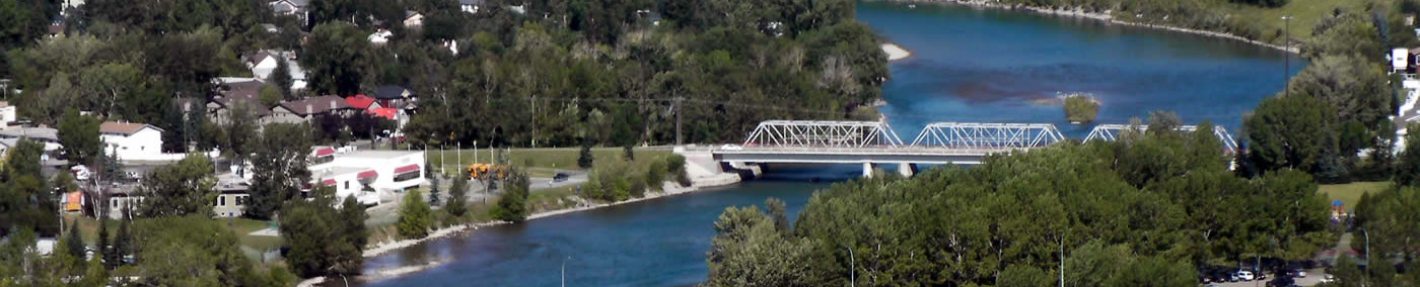
BRFM advocates for infrastructure on the Bow River to keep flood water above 800 m3/s outside of the City. At flow rates above 800 m3/s ground water flooding begins to cause significant damage.
Upstream Mitigation for the Bow River: Currently In Place
At present, the only upstream flood mitigation available on the Bow is the “TransAlta Modified Operating Agreement” (the TA Agreement), which involves lowering the Ghost Reservoir each spring in preparation for both spring runoff and major rainstorms.
In 2016, the Government of Alberta (GoA) negotiated a 5 year agreement with TransAlta to set elevations on the Ghost reservoir during the highest storm risk period of the year typically from mid May to early July). The agreement was subsequently extended for another 5 years, expiring on April 1, 2026. Keeping the reservoir lower provides more water storage capacity, allowing for decreasing and/or delaying peak flow rates downstream from the dam. These controls could amount to upwards of 20% of the peak flow rate of 1840 m3/s that was observed in 2013, representing a reduction of flood risk for all communities downstream of the Ghost Dam, including Bowness. More information on the TA Agreement can be found on the GoA website: https://open.alberta.ca/publications/bow-river-transalta-agreement-fact-sheet.
Upstream Mitigation for the Bow River: Upcoming Projects
Phase 2 of the Bow River Reservoir Options Initiative (BRRO) evaluated 3 potential upstream storage options. This assessment, conducted by the engineering firm Wood Canada Ltd, was completed in March 2025 with the GoA selecting the “Ghost River Reservoir Expansion” option. The BRRO initiative is now known as the Ghost River Infrastructure Project (GRIP) with Phase 3 being led by the Ministry of Transportation and Economic Corridors. Phase 3 includes engineering and design, combined with environmental regulatory approvals.
The Phase 2 Feasibility Study report and the Alternatives Assessment report were released to the public in October 2025. BRFM is currently reviewing the findings.
In addition to The Phase 2 Feasibility Study and the Alternative Assessment Reports, details about this project are available on the BRRO website. (https://www.alberta.ca/bow-river-reservoir-options)
Upstream Mitigation for the Bow River: How much is needed?
Much more storage than the TA Agreement is needed to protect against a flood event in Bowness even of the magnitude that experienced in 2013 (now assumed to represent a 1:75 year event). It has been widely acknowledged by various experts that to fully manage an event similar to that of 2013, a reservoir on the Bow River with the capacity to hold the volume of three Ghost Reservoirs is required.
Key questions in determining the amount of upstream mitigation required to protect a community are:
- What flow rate can the river handle before overland and groundwater flood damage occur (measured in m3/s)? and
- What size of flood event are you aiming to avoid?
Detailed groundwater studies contained within the Klone Crippen Berger (KCB) reports commissioned by the City showed that overland flow, and localized groundwater flooding, will commence Bowness at any flow rate exceeding 800 m3/s. For this reason, it is the position of both BRFM, and the CRCAG (Calgary River Communities Action Group) Board that “the protection provided by upstream infrastructure on the Bow River must be evaluated with 800 m3/s as the maximum peak allowable flow.”
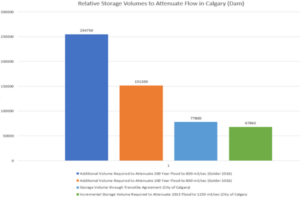
The graph below shows the required reservoir volume to attenuate the peak flow for the 100 and 200 year flood events to 1230 m3/s and the recommended target of 800 m3/s
CRCAG advocated for residents along the Elbow River, ultimately resulting in the GoA’s construction of the Springbank Off-stream Reservoir (SR-1). The storage capacity now available in this reservoir protects Elbow River communities from both groundwater and overland flooding up to a 1:200 year flood event by limiting the flow rate on the Elbow River. BRFM believes in equitable treatment for all communities and therefore advocates for a peak flow rate of 800 m3/s in a 1:200 year flood event.
Unfortunately, the “Ghost River Reservoir Expansion Option” recently selected by the GoA will likely provide only a fraction of the additional storage required to limit the flow rate on the Bow to the 800 m3/s required in a 1:200 year flood event. It is projected that this option will protect communities on the Bow up to a 1:75 flood event, assuming a maximum flow rate of 1230 m3/s.
Note that all engineering work done to date suggests significant flood damages for hundreds of homes in Bowness at this flow rate; hence BRFM’s and CRCAG’s continuing advocacy for the construction of additional upstream storage capacity designed to limit the flow rate on the Bow to 800 m3/s for up to a 1:200 year flood event.
Upstream Mitigation for the Bow River: What else can be done to get the flow rate down to 800 m3/s?
In addition to BRFM’s and CRCAG’s positions on the maximum allowable flow rate through Bowness, both organizations are currently advocating for the evaluation and construction of additional infrastructure upstream of Calgary by the GoA. As stated on the CRCAG website:
“We recognize the Relocated Ghost Dam option alone will not provide full flood protection to
every Bow River community and we will therefore continue to advocate for the Government to
determine one or more additional projects, or an alternative project, to achieve flood protection
for all of Calgary for a 1 in 200 year flood event. For example, the Government is currently
pursuing Alberta’s “Water Storage Opportunities Study” to identify and rank suitable locations
for water storage across the province to boost water security and protect against drought and
floods. In carrying out that study, we encourage the Government to thoroughly evaluate the
“Benchlands Reservoir and Pumped Storage Hydropower Project” proposed by the Bowness
Responsible Flood Mitigation Society, which may have the potential to address water storage,
flood mitigation and power generation. The potential flood mitigation capacity of the Benchlands
project could help address the gap in flood protection on the Bow River that will exist even if the
Relocated Ghost Dam project is completed”.( https://protectcalgary.com/2025-position-statement-bow/)
Information and updates on the GoA’s current Water Storage Opportunities Study can be found at https://www.alberta.ca/improving-water-storage